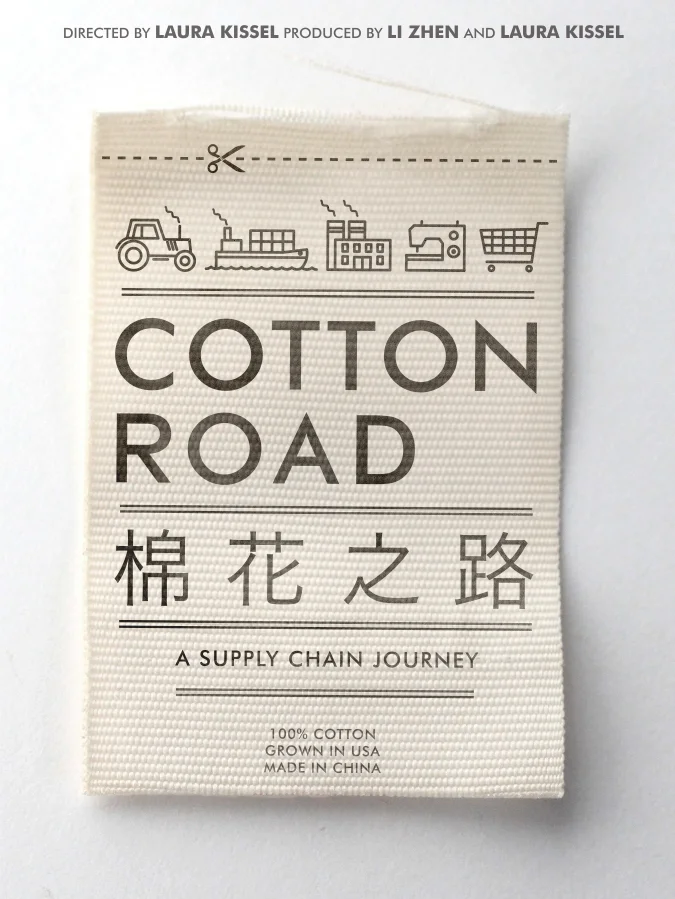
Category: textile industry


Changzhou, Jiangsu Province

March 26th, 2009 — 04:46 pm

handsOn Monday this week we had a successful trip to Changzhou, a city of about 2 million in Jiangsu Province that is located about a 2.5 hour drive from Shanghai.  Changzhou is a booming textile town, but also known for other types of manufacturing.  In Changzhou we met with our contact, Mrs. Ding, a woman who has her own company as a buyer of textile products.  Mrs. Ding is a middle person; she places orders with factories for the production of textiles and clothing. She introduced us to Mrs. Zhang, the niece of the owner of Shen You yarn and weaving factory, a small and efficient factory that employs about 10o people to manufacture textiles.

Our time at Shen You was fantastic.  We had a tour and I shot a little bit of video; we have been given the opportunity to return to Shen You for more in-depth filming, which I greatly look forward to.  Mrs. Zhang and Mrs. Ding led us through the factory, starting from the point where the yarn is spun off giant spindles and tied onto a large barrel, the first step in setting the design of the fabric. weaving5 Next, the yarn is threaded onto “needles” [we don't yet have the technical terms] that will ultimately form the fabric when they are connected to the weaving machine.  This part has to be done by hand; there is no other way.  We entered a room where there were about 4 stations set up to prepare the patterns.  Young women sit across from each other and hand thread back and forth until they have completed the pattern.  This work seems to require quite a bit of concentration to complete, and the room was rather quiet. Next, the machines are loaded with these threads and the fabric is woven.  Standing in the weaving room, I couldn’t help but think about  the textile factories that used to be scattered all over the Carolinas. The scene was so familiar to me given the hundreds of images I’ve seen of textile mills in the South.

inspection2When the fabric is finished, it is taken to a large room with tables, spread out, and examined for flaws.  Young women are unfolding fabric and examining it inch by inch for inconsistencies and making repairs by hand if they find any problems.  The young women here were laughing and talking to one another.  They told me that they would have dressed up if they knew an American director was coming to film them!  I was rather taken by these young women, many of whom are probably migrant workers; they are incredibly fresh, open and witty.  I am really looking forward to returning to Shen You for more filming, hopefully next week.

I hope, too, that we’ll be able to follow Mrs. Ding as she places orders for textiles.  We stopped off at a factory with her on our way to Shen You and waited outside the factory gates.  On either side of the gate were rows of small shops and pedi cabs and trucks were driving up and down the small street piled high with textiles.  A large truck rambled by filled to the top with bolts of denim, and then a small pedi cab crept past.  Mrs. Ding explained that when factories have a very big order and not a lot of time to fill it, they will hand off part of the order to very small, family owned textile companies that are run out of peoples’ homes.  We hope we’ll be able to film in one of these small factories, too.

inspection  hands3 girls

Comment » | Jiangsu Province, cotton road movie, textile industry, weaving

nothing is wasted

March 17th, 2009 — 08:28 pm

scraps3Yesterday I filmed again at Yuan Tian Clothing Factory with a few of the workers, but the majority of my time was spent watching the loading of a truck with months worth of cotton scraps from the factory.  Everything has value in the production chain at Yuan Tian; nothing is wasted. Mrs. Jiang and her managers spent the better part of the afternoon overseeing the weighing of bags of cloth scraps as they were loaded. The workers doing the loading were hired by another factory to haul the scraps.  They weren’t entirely sure what the scraps were going to be used for, but Mrs. Jiang noted that some would be used to make toys, some would be shredded and used as insulation in electronic instruments like calculators.  The polyester fibers would be melted down, and perhaps used to make plastic for electronic parts. 

scrapsLoading was incredibly dusty work.  The workers kept throwing bag after bag into the truck and insisting that everything would fit.  Mrs. Jiang and her staff suggested they come back the next day and do two loads, but the workers disagreed. They finally finished around 5 pm, strapped down the towering load, and drove off.  Elizabeth Peng, my translator for the day, and I got into a cab about 5 minutes later to head home. As our cab rounded the block we saw the truck stopped on the side of the road by a police officer who was writing the men a citation for the precariousness height of their cargo.

Comment » | clothing, cotton road movie, textile industry

沙 and 线 in Ningbo

February 22nd, 2009 — 12:41 pm

bridgeYesterday Li Zhen and I went on our first shoot in Ningbo, China at the Weike Mian Fang factory. To get there we had to drive about 3 hours, which included the shortcut of the Hangzhou Bay Bridge, the longest bridge in the world. Kenny Zheng drove us to Ningbo and expertly navigated once we were there. The image here is from the Hangzhou Bay Bridge at night, on our return home.

Surprisingly, we were granted permission to film at Weike Mian Fang right away, which we weren’t expecting. Li Zhen explained to the factory manager that we would like to film longer, to talk to the workers and spend more time in the location. He did not initially understand this but told us that once we finished shooting, we could discuss this possibility.  We couldn’t find him when we finished for the day, so our next step is to follow up with him to determine if it will be possible to return.

discarded cottonWeike Mian Fang is part of the larger Veken Textile Company, but they only produce cotton thread and some kind of polyester fabric. One side of the factory was devoted to the processing of large bales of polyester from Malaysia. In this same large room cotton was also being processed. Large machines slowly combed through piles of raw cotton to separate the trash. The clean cotton becomes thread and the dirtier cotton is separated for other products, like blue jeans, or it is thrown away.  A room adjacent to the area where raw cotton arrives from the Port of Ningbo contains large bags dirty, raw cotton that has been discarded by the thread manufacturing process.

What is consistent from the U.S. all the way to China is the smell of cotton. Weike Mian Fang smells just like the gin in Cameron, South Carolina and the warehouses in Savannah, Georgia. I was not expecting this, and yet I recognized it as soon as I stepped onto the factory floor.  Cotton has an “organic” smell, like crushed, dried twigs mixed with fresh air.  I was also caught off guard by how few workers I saw in the factory; Weike Mian Fang appeared almost empty to me and people were scarcely to be seen. workerningboI caught glimpses of workers, manning the larger machines.  But when raw cotton is being spun into thread, the machine dominates– it fills the room.  Isle upon isle of small, robotic arms rhythmically do the work of spinning threads - 沙 (sha1)- and then making these threads into one, long line on a spool:  线 (xian4).  Even if it would have been possible to speak to any of the people we saw in the factory, they would have scarcely been heard over the din of the machines.

threadpackingningboAt the end of the production line in a room (thankfully) lit by daylight, about 4 or 5 workers were packing the 沙 into cardboard boxes.  This 沙 is heading to Japan.  In this room we did a small amount of filming and we also spoke to one of the workers on camera who became immediately shy.  We did learn that she is from Ningbo and has worked here for a long time, perhaps about 30 years  So, she would have worked here when Weike was a state-owned enterprise.  Now it is partnership between state and private, we think.  Li Zhen will research this.  

I think Li Zhen and I had a good start on Friday, but the kind of filming I did felt like practice:  it was an opportunity to be in this environment for the first time, to get a visual understanding of the space, and to see what it is like for raw cotton to become a product. It was also a chance for Li Zhen and I to practice working together, and to get a sense of how we will proceed. I also had some technical trouble:  the factory floor is very dim; I had to boost gain and shoot wide open the entire time.  The florescent lights that vaguely lit the factory were also off ballast, so the images are pulsing with a fuzzy, black bar that scrolls from bottom to the top of the screen.  (Thanks to Mark Gamble for standing “on call” in Columbia to research how I might fix this problem next time!) We will ask Mr. Zhou if we can return to Weike Mian Fang, and we’ll also ask if they can enable access to the Port of Ningbo, so that we can see the raw cotton’s arrival and transport to the factory. Weike Mian Fang was using American cotton, by the way– the bales we saw were from Mid Valley Cotton Growers, in Tulare, California; gin number 96208.
california cotton calendarningbocottoncleaning

Comment » | Ningbo, cotton road movie, textile industry

hands vs. machines

February 1st, 2009 — 04:11 pm

Yesterday I met with Ms. Xiaobo Lu, a business woman who works in the textile industry in Shanghai.  We spoke at length about the chain of production for textiles here in Shanghai.  Ms. Xiaobo Lu is a buyer; she is hired by wholesalers in the U.S. who place orders with her that they want filled in Chinese factories.  She takes the order, makes contact with weaving and textile factories, and arranges to have the order filled and delivered.  She doesn’t often know who is placing the order directly because she only deals with the wholesaler, who is in New York.  Her profit margin is very slim because there are many middlemen. I now understand the production flow of textile production as:

raw cotton bale-> shipped to China by cotton merchant (purchased by mill)-> transported to a yarn factory-> yarn transported to a weaving factory-> fabric transported to a dye factory-> completed fabric transported to a sewing factory-> completed product shipped to a warehouse-> product loaded into a container-> shipped back to the U.S.-> transported to the wholesaler’s warehouse-> sent to the department store-> purchased by consumer. 

Depending on the size of the textile business, the yarn making, weaving, and dying may take place in the same factory, or in separate factories.  Ms. Xiaobo Lu has relationships with several mills and sometime soon will make contact to arrange a tour so that I can see the entire process and seek permission to film over time.  We also talked about the current state of the economy and economic change in Shanghai.  Ms. Xiaobo Lu began her business in New York a number of years ago; she moved back to China in the early 1990s when a lot of the weaving of cotton into material was still done by hand.  In 1992 the infrastructure was still rather poor and “the machine was more expensive than labor.”  Around 1996/1997 she saw a dramatic change in the quality and productivity of Chinese textile factories. Factories moved to China from places like Taiwan and Korea; investors brought technology and new methods of production.  Around this time a lot of new orders began to be placed through her company.  Now, “hands are more expensive than machines” in China.  Textile mills are closing and the industry is starting to move to places like India, Vietnam, and Pakistan.  Fewer orders are being placed because of the global economic slowdown.  She reported that there are still a lot of orders coming in from middle and lower level clothing companies like T.J. Max, Marshalls, WalMart.  Another change that recently occurred in China is that export licenses are no longer needed to start a business like the one that Ms Xiaobo Lu operates.  This pretty much means that anybody can set up shop as a buyer and field orders from overseas.

pearltower

The location of our meeting was the Super Brand Mall, an enormous shopping plaza in Pudong across from the Pearl Tower.  (The photo here shows the base of the Pearl Tower and all the tourists lined up to go to the top.) There are about 9 floors to the Super Brand Mall (not counting the basement, which contains an awesome, giant food court.  It seems one can satisfy just about any desire here:  go to the gym, take a yoga or English class, or shop for clothes/electronics/books/cosmetics at hundreds of stores. When our meeting ended, I decided to walk around the mall; even though I have been to Super Brand before, I haven’t even seen half of what it has to offer.  Quite perfectly, I ended up wandering right by a store called ECOH: Organic and Natural Lifestyle which sells bedding, robes, towels, scarves and other textile products made from organic cotton and bamboo. organicsign It was interesting to note the ideas conveyed through the images post around the store and on packaging, notions such as purity, abundance, and the idea of “green”.  I will have to come back here with someone who reads Chinese. Searching for the website for ECOH I also found reference to the organic movement in China, which I assumed was almost nonexistent, but apparently it is growing. I even discovered that I can visit an organic farm near Shanghai and order food from that farm, delivered to my neighborhood. Baby Bok Choy is only 5 RMB, which is less than $1. As in the U.S., organic food and products seem to be targeted towards those who can afford it, but after shopping for groceries today in my neighborhood Chinese grocery store I found a large assortment of produce labeled “organic”.  I saw maybe 2 other westerners in the store the whole time I was there, so I can only assume the idea of organic is catching on.

Comment » | textile industry